Introduction: Why Most Short-Term Rentals Underperform
There are thousands of Airbnb listings in the Lake District and across Cumbria. Most of them are fine. A decent property, a few photos, a generic description that could apply to any holiday cottage in the country. And that is precisely the problem.
Fine does not fill a calendar. Fine does not command premium pricing. Fine does not generate the kind of five-star reviews that drive your listing up the search rankings and keep it there. Fine is the baseline, and the baseline is crowded.
The short-term rental market in this region has matured. Guests are more discerning than they were five years ago. They have stayed in more properties, read more reviews, and developed a sharper sense of what they are getting for their money. When they book a Lake District cottage at £200 a night, they are not comparing it to a budget hotel. They are comparing it to the last premium property they stayed in.
Carl McGlassonI have been cleaning, managing, and working inside short-term rental properties across Cumbria for years. The properties that consistently perform — high occupancy, strong pricing, great reviews, repeat guests — are not always the most expensive or the most impressive-looking. They are the ones that know exactly who they are for and deliver that experience without compromise. The ones that struggle are almost always the ones trying to be everything to everyone and ending up as nothing to anyone.
This guide is about fixing that. It is about understanding the principle that separates consistently high-performing STRs from the rest: know your niche, meet their needs, and build every single decision about your property around the people you want in it.
This is not a guide about how to list on Airbnb or how to take better photographs. There are plenty of those. This is a strategic guide about positioning, targeting, guest experience, and operational excellence — the things that actually move the needle on your revenue and your reputation.
Section 1: Know Your Niche — The Foundation of Everything
Why niche positioning is not optional
The instinct most STR hosts have when they start out is to make their property appeal to as many people as possible. Neutral decor. Vague descriptions. A listing that mentions families, couples, walkers, and business travellers in the same paragraph. The logic makes sense on the surface — if you appeal to everyone, you maximise your potential bookings.
The reality is the opposite. When you try to appeal to everyone, your listing speaks to no one with any conviction. Guests scroll through dozens of options. The ones that stop them and make them click are the ones that feel like they were made for them specifically.
Carl McGlassonThink about how you feel when you land on a product page and the description feels like it was written exactly for your situation. That feeling of recognition — ‘this is for me’ — is what drives bookings. You can only create that feeling if you have decided who you are talking to.
Niche positioning does not mean excluding people. It means that your primary design, messaging, and operational decisions are built around a specific type of guest. When you do that well, those guests book you consistently, pay your rates, leave strong reviews, and come back.
The main STR guest niches in Cumbria and the Lake District
The Cumbrian market has a number of well-defined guest segments. Understanding which one (or which combination) your property is best suited to serve is the starting point for every decision that follows.
Couples and romantic getaways
One of the largest and most lucrative segments in the Lake District. Couples are typically looking for seclusion, atmosphere, quality, and the feeling that the property was designed with them in mind. They tend to book at higher rates, are less price-sensitive than family groups, and care intensely about the details — the quality of the bedding, the bath or hot tub, the lighting, the view.
What they need: Privacy. Atmosphere. Quality touches. A property that feels special, not functional.
Walking and outdoor adventure groups
Boot rooms, drying facilities, dog-friendliness, early breakfasts, proximity to trails, bike storage — these things matter far more to this guest than the quality of the scatter cushions.
What they need: Practicality. Storage. Dog-friendly spaces. Proximity to trails. A property that works hard as a base camp.
Families with children
Families are looking for space, safety, and the practical infrastructure that makes a trip with children manageable rather than stressful. They care about the garden, the proximity to child-friendly attractions, the quality of the kitchen, and whether the property genuinely accommodates children or merely tolerates them.
What they need: Space. Safety. A proper family kitchen. Gardens. Child-friendly logistics.
Remote workers and workcations
Reliable fast broadband is non-negotiable. A dedicated workspace — even just a proper desk and chair in a quiet area — is a genuine differentiator. These guests tend to be respectful, clean, and are often looking to come back to the same reliable property repeatedly.
What they need: Fast, reliable broadband. A proper workspace. Quiet. A comfortable environment to spend long periods in.
Multi-generational groups and large gatherings
Larger properties hosting extended family groups, celebrations, or reunions serve a niche that is underserved relative to its size and willingness to pay. What they require is genuine capacity — enough beds, enough bathrooms, a kitchen that can function for ten people, and enough communal space.
What they need: Real capacity. Multiple bathrooms. A kitchen that works at scale. Communal space. Outdoor entertaining.
Choosing your niche
Start by being honest about what your property is. Then ask which of the above niches is the natural fit — and then go hard on delivering for that niche rather than hedging. The properties that perform best in this market are the ones that lean into what they are rather than apologising for it.
Carl McGlassonOne of the most common mistakes I see is hosts trying to add a child’s travel cot and a dog bowl to a property that is clearly designed as a couples retreat and calling it ‘family-friendly.’ It does not make the property more bookable. It makes it feel confused. Decide who you are for and commit to it.
Section 2: Design and Presentation for Your Target Guest
The design brief you have not written
Before you make any purchasing or styling decision for your property, ask one question: does this serve my target guest? If the answer is no, it should not be in the property. If the answer is yes, it should be done properly.
Couples and romantic properties
The design priority is atmosphere over function. Lighting is your most powerful tool — layer it so the property can be made dim and intimate in the evenings. Quality bedding is non-negotiable. A bath — freestanding if possible — converts extremely well. If you have the space, a hot tub adds significant booking and pricing power.
Details that convert: a bottle of local wine or prosecco on arrival, a fire pit or wood burner, a locally-sourced welcome hamper, bath products worth using, a sound system, blackout curtains, and the complete absence of anything that looks like it belongs in a waiting room.
Walking and outdoor properties
Function first, aesthetics second. A boot room or wet room with boot dryers, hanging space for wet gear, somewhere to clean muddy boots that is not the kitchen sink. Dog-friendliness is a major commercial advantage in this segment. Maps, local walking guides, and a curated list of routes from the door will be used and appreciated.
Family properties
Hard-wearing surfaces that clean easily. A kitchen with a full-sized oven, dishwasher, and enough crockery and cookware for the full group. A tumble dryer — non-negotiable for families. A secure garden, somewhere for children to play, a barbecue, and enough outdoor seating for the adults.
Remote worker properties
Broadband speed should be tested and the actual result displayed in your listing — not vague references to ‘good WiFi.’ A dedicated desk and an ergonomic chair where someone can work for six hours without back pain. Good lighting, enough outlets, quiet, and a kitchen they can cook in properly.
Section 3: Cleaning and Presentation Standards
The standard guests actually expect
The baseline expectation is no longer ‘clean.’ The baseline expectation is immaculate. A single strand of hair in a bathroom, a smear on a mirror, or a kitchen surface that has not been properly cleaned behind the appliances is enough to generate a comment in a review — and a negative cleanliness comment is one of the most damaging things that can happen to an Airbnb listing.
Carl McGlassonI have seen properties with genuinely beautiful interiors tanking their ratings because the cleaning was inconsistent. And I have seen relatively modest properties maintaining strong ratings and strong occupancy because the cleaning was impeccable every single time. The clean is not a background task. It is the most important operational element of your STR.
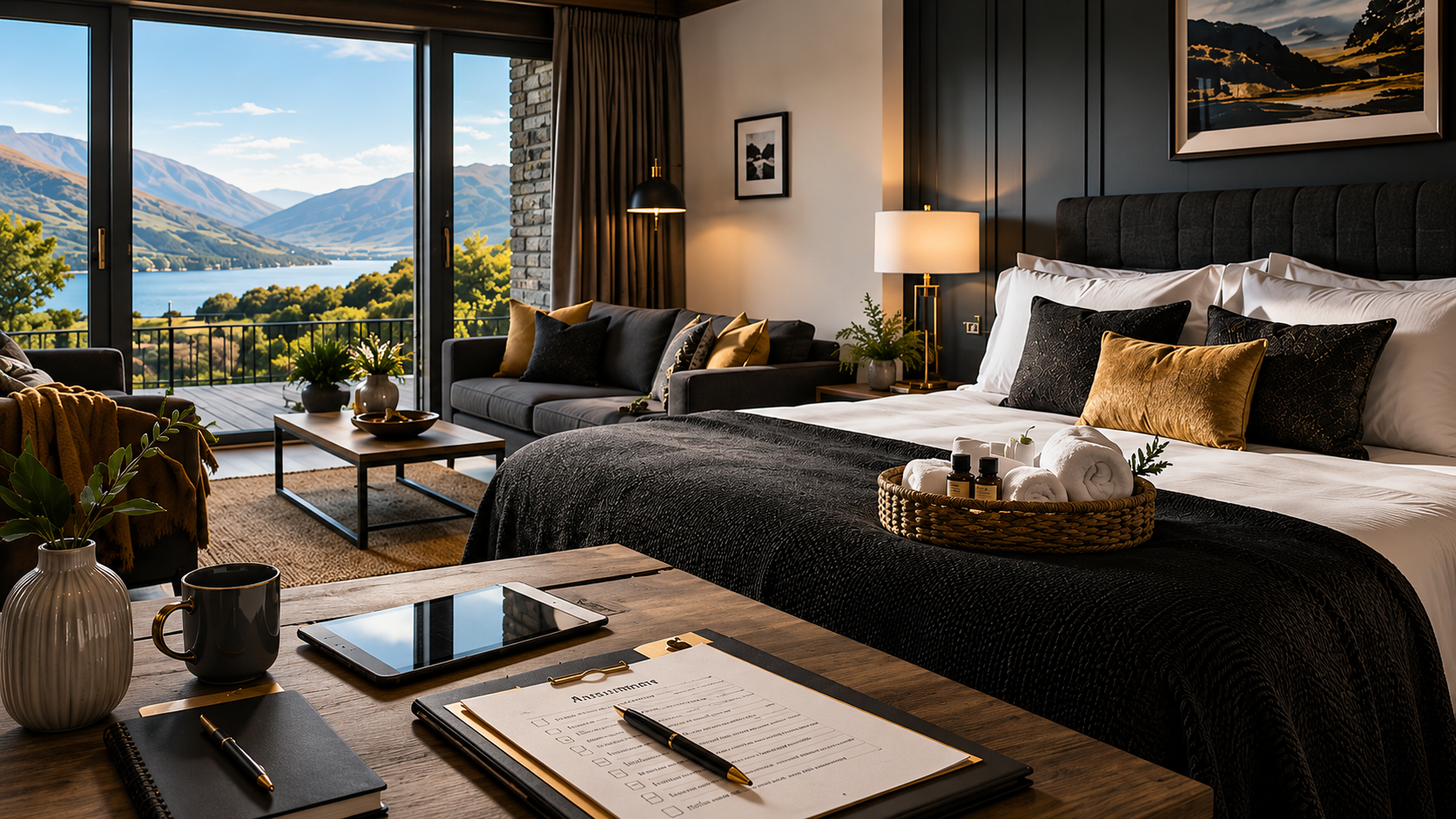
The standard we work to at Cumbria Bright is hospitality grade. Hospitality cleaning is systematic, checklist-driven, and verified — not just cleaning what is visible but cleaning what a guest will find when they open a cupboard, check under a bed, look behind a tap, or pull back a shower curtain.
The turnover clean
We work ceiling to floor, room by room, in a consistent order. In the kitchen: every surface including the underside of cabinets above the worktop, the hob (under the burner caps), the oven interior, the microwave, the fridge interior including the door seal, inside every used drawer and cupboard, and behind appliances where accessible. In the bathrooms: limescale is the enemy — every surface descaled properly, not just wiped down.
Linen and towels should be presented to hotel standard. Not washed and piled. Presented — properly made beds, hospital corners or pressed duvet presentation, towels folded and placed.
The linen operation
Linen management is the logistical challenge most individual hosts underestimate. The solution is a managed laundry service that integrates with your cleaning schedule. At Cumbria Bright we provide exactly this through Zippy Bright — our in-house laundry operation that collects linen at the end of a clean, launders it to commercial standard, and returns it in time for the next turnover.
The post-clean check
Every clean ends with a structured walkthrough against a checklist. We photograph properties at the end of every clean, which creates a record of condition and forces the team to look at the property the way an arriving guest would. Issues — a broken lamp, a worn towel, a stain, a lightbulb gone — are flagged immediately, not left until the next booking.
Section 4: The Guest Experience Beyond the Clean
First impressions are made before guests arrive
The guest experience starts at the moment of booking. A prompt, warm, informative confirmation. A pre-arrival message that gives them everything they need without requiring them to hunt for information. Smart locks or key boxes are standard expectation now — if you are still doing manual key handovers, you are creating friction at the most important moment of the guest experience.
The arrival experience
The first five minutes set the tone for the whole stay. A property that looks exactly as good as the photographs, smells fresh, is warm and well-lit, and has a welcome that feels considered will generate positive emotional energy that carries through the stay. Local products — Cumbrian chutney, local biscuits, a small bottle of local gin — and a handwritten note addressing guests by name will outperform any generic welcome pack.
Carl McGlassonThe properties I have seen that generate the most repeat bookings and the warmest reviews are almost always the ones where the welcome is genuinely personal. It does not take much. It just takes thinking about it from the guest’s perspective rather than treating it as an operational checkbox.
The property guide and local knowledge
Every STR needs a comprehensive, well-designed property guide. Not a laminated A4 sheet with the WiFi code and the bin collection day — a genuine guide that helps guests make the most of their stay: the best walks from the door, the restaurants worth booking, the pub locals actually go to, the hidden viewpoint, the Saturday farmer’s market.
Handling issues during a stay
A guest who experiences a problem and receives an immediate, helpful, friendly response will often leave a better review than a guest who had a perfect stay with nothing to test the host’s responsiveness. The standard is not perfection — it is how you handle imperfection.
Section 5: Pricing, Occupancy, and the Revenue Mindset
The relationship between quality and pricing power
The mistake many hosts make is competing on price. The better strategy is to price at a premium justified by quality, accumulate the reviews that confirm that quality, and operate a calendar that is full at your rate rather than full at a discounted rate.
Carl McGlassonPrice signals quality. Price below your quality and you attract guests who expect less, treat the property as if it is worth less, and sometimes review it as if it is worth less.
Dynamic pricing
Tools like PriceLabs, Beyond, and Wheelhouse automate dynamic pricing using market data. Even a basic tiered structure with peak, shoulder, and off-peak rates adjusted manually will significantly outperform a flat annual rate. Use minimum stay requirements at weekends and bank holidays to protect against high-cost single-night bookings.
The occupancy versus rate trade-off
A property running at 75% occupancy at a strong rate will typically outperform a property at 90% occupancy at a discounted rate — and will do so with considerably less wear and lower cleaning costs relative to revenue.
Section 6: Reviews, Reputation, and the Compound Effect
On Airbnb and Booking.com, reviews are the algorithm. The compounding effect of a consistent five-star operation over twelve to eighteen months is a listing that sits near the top of search results for its area and category with minimal ongoing marketing spend.
Generating reviews
A single, warm, timely message after checkout — thanking guests for staying and mentioning that a review would mean a great deal to a small independent business — significantly increases the percentage of guests who follow through. Do not be robotic about it.
Responding to reviews
Respond to every review, positive or negative. A host who responds badly to criticism — defensively, dismissively, or passive-aggressively — damages their listing far more than the original critical review did. Future guests are not just reading the reviews. They are reading how you respond to them.
Section 7: Operations at Scale — From Host to Operator
The mindset shift from host to operator is one of the most important transitions in STR business development. An operator thinks in systems. They ask not ‘how do I do this’ but ‘how does this get done consistently whether or not I am involved.’
Carl McGlassonThe hosts I see building genuinely scalable STR businesses are the ones who treat their property operation the same way they would treat any other business — with systems, standards, accountability, and data. The ones who stay stuck doing everything themselves hit a ceiling of complexity and exhaustion that limits both the quality of their guest experience and their ability to grow.
Building your operational team
The core relationships every serious operator needs: a reliable cleaning partner, a reliable laundry partner (or one partner providing both), a responsive local maintenance contact, and a trusted property manager or co-host. The cleaning partner is the most important — your cleaner determines the state of your property at the moment every guest arrives.
Systems and technology
Channel management software — Guesty, Lodgify, Hostaway, Smoobu — becomes important as soon as you are managing more than one or two properties. Automated messaging saves significant time once properly set up. Property management software that tracks revenue, occupancy, and review performance turns gut feeling into data.
Conclusion: The Property That Performs Is the Property That Is Built With Intent
Everything in this guide comes back to one principle: know exactly who your property is for and build every decision around them without compromise. Niche clarity. Design and presentation. Cleaning and linen standards. Guest experience. Pricing strategy. The review operation that converts strong stays into the social proof that fills your future calendar.
None of these things are complicated in isolation. The difficulty is doing all of them consistently, at standard, across every single booking, whether you have one property or ten, whether it is peak summer or January. That is what operational excellence in the short-term rental market actually looks like. Not perfection — consistency.
Carl McGlassonIf you are operating in the Lake District and Cumbria market, you are in one of the most beautiful and most competitive short-term rental markets in the UK. The opportunity is significant. The bar is rising. The hosts who will dominate this market over the next five years are the ones who are building their operation with the kind of intent and rigour that this guide describes.
Cumbria Bright exists to support STR hosts and property managers across this region — with professional cleaning, managed linen services through Zippy Bright, and the operational expertise that comes from working inside this market every day. If any part of this guide resonates with where you want your operation to be, we would be glad to talk.