
The Brutal Truth About the Lake District Airbnb Market: Why Some Holiday Lets Print Money While Others Quietly Fail
Inside the widening gap between professional operators and invisible listings in an increasingly professionalized short-term rental economy — and why owning a pretty cottage no longer guarantees profit.
The Lake District Gold Rush Isn't What Most Owners Think It Is
For years, the Lake District looked like an easy-money machine for Airbnb hosts. Buy a pretty cottage. Add a hot tub. Upload a few photos. Wait for bookings.
That fantasy fueled a wave of amateur operators entering one of the UK's most competitive holiday-let markets. From Windermere to Keswick, Ambleside to Grasmere, thousands of owners rushed in believing tourism demand alone guaranteed success. But beneath the postcard-perfect surface, the market has changed dramatically.
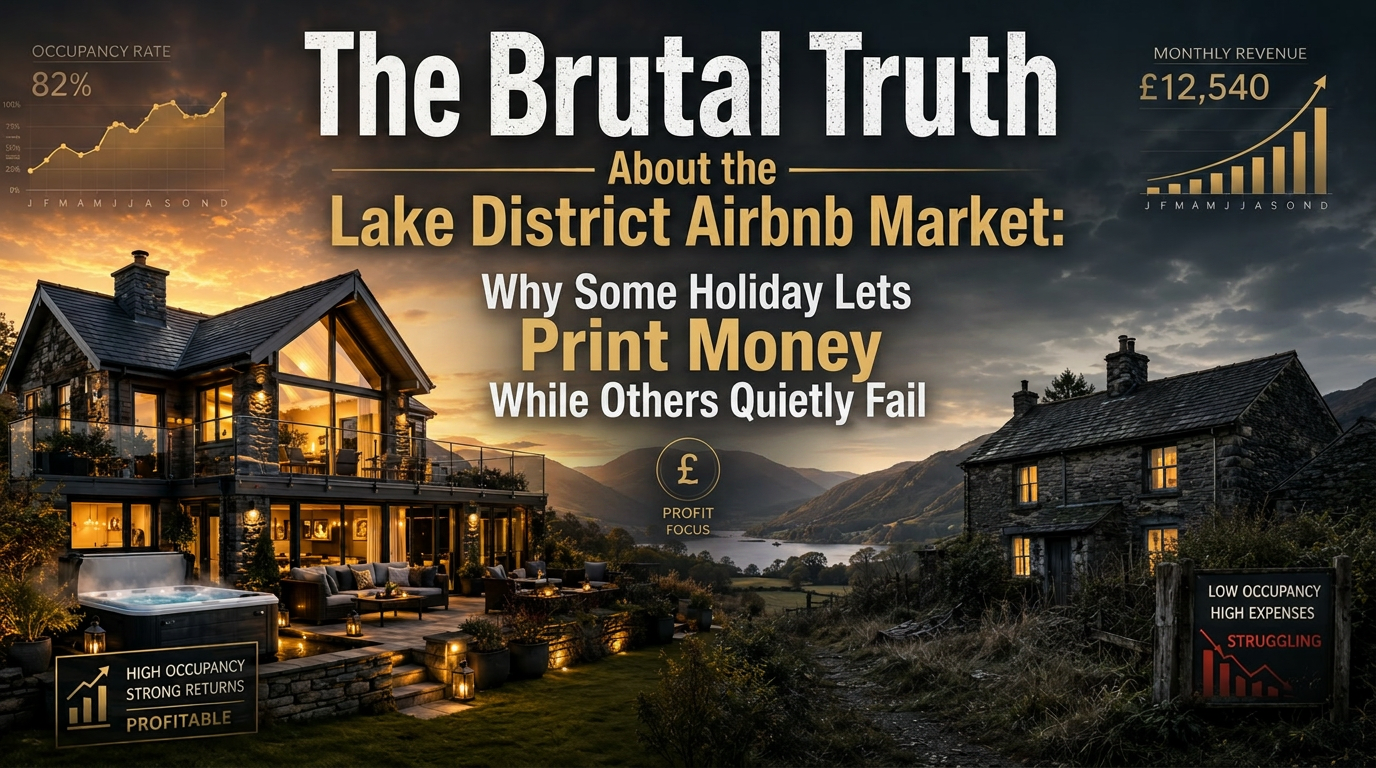
Today, the Lake District Airbnb economy is splitting into two completely different worlds: professional operators running optimized, branded, revenue-managed businesses generating exceptional profits — and invisible listings quietly bleeding cash, struggling for occupancy, and falling further behind every season. And the gap between them is widening fast.
Some holiday lets now earn six figures annually with year-round occupancy. Others barely survive winter. Many owners are discovering — far too late — that simply owning property in the Lake District no longer guarantees profitable short-term rental income.
The brutal truth? The market has matured. Competition exploded. Guest expectations skyrocketed. Algorithms became ruthless. Regulations tightened. Operating costs surged. Meanwhile, many hosts are still playing by 2018 rules in a 2026 marketplace.
The Lake District Airbnb Market Has Become Saturated
The pandemic changed UK travel permanently. When international travel shut down, domestic tourism exploded. Suddenly, the Lake District became one of Britain's hottest staycation destinations. Occupancy rates surged. Nightly prices climbed rapidly. Social media amplified demand. That boom triggered an investment frenzy.
Thousands of buyers entered the market believing short-term rentals offered passive income and rapid property appreciation. Local cottages were converted into holiday lets at unprecedented speed. For a while, nearly everyone won. But saturation always catches up.
Today, many towns across the Lake District — Windermere, Bowness-on-Windermere, Keswick, Ambleside, Coniston, Grasmere — are flooded with listings competing for the exact same guests. And when supply explodes faster than demand, weak operators get exposed quickly.
A few years ago, mediocre listings could still achieve strong occupancy because demand exceeded supply. That era is over. Higher mortgage costs, increased cleaning expenses, rising utility bills, Airbnb service fees, more competition, guest price sensitivity and algorithm changes have all combined to compress margins. Owning a holiday let is no longer enough. Running one professionally is what matters now.
Professional Operators Are Dominating the Market
The top-performing Lake District holiday lets are no longer run like side hustles — they're run like hospitality brands. That means operators focus obsessively on revenue management, dynamic pricing, SEO optimization, guest psychology, professional photography, review engineering, automation systems, brand positioning, occupancy forecasting and conversion optimization. In other words, they operate more like boutique hotels than casual Airbnb hosts.
Airbnb's algorithm rewards listings that maximize platform revenue and guest satisfaction. That means it favors properties with high click-through rates, strong reviews, fast response times, frequent bookings, low cancellation rates, competitive pricing, consistent availability and strong guest engagement. Professional operators optimize every single one of these variables. Amateur hosts often optimize none of them.
The consequence is brutal: successful listings become more visible, generating even more bookings. Weak listings become increasingly invisible.
The Invisible Listing Problem Is Getting Worse
Very few owners openly admit their Airbnb is underperforming. Instead, failure happens slowly and silently. It looks like occupancy gradually declining, weekday bookings disappearing, winter calendars remaining empty, guests negotiating discounts, revenue flattening despite rising costs, reliance on peak summer weeks and increased dependence on last-minute bookings. Many owners convince themselves the downturn is temporary. Often it isn't.
One of the harshest realities in modern Airbnb markets is algorithmic invisibility. Listings that fail to generate engagement lose ranking position. Fewer guests see the listing, fewer clicks occur, bookings decline, ranking worsens further, visibility collapses. It becomes a negative feedback loop. Meanwhile, high-performing listings receive disproportionate exposure. This creates a winner-takes-most market.
The Lake District Guest Has Changed Dramatically
Five years ago, many guests accepted basic accommodation. Not anymore. Modern travelers expect luxury interiors, fast Wi-Fi, stylish design, premium beds, smart TVs, hot tubs, Instagrammable aesthetics, coffee machines, work-friendly spaces and flawless cleanliness. The old 'cosy cottage with character' approach no longer guarantees success — especially when guests compare dozens of listings instantly.
Interior design has become a pricing weapon. Properties with professionally curated interiors consistently outperform outdated competitors. Guests increasingly book emotionally, not rationally. Lighting matters. Color palettes matter. Photography matters. Layout matters. Branding matters. A dated cottage with poor photos may lose bookings to a smaller property with exceptional visual appeal. Perception drives profitability.
Why Photography Makes or Breaks Holiday Lets
Guests don't initially search emotionally for villages. They search visually. The listing thumbnail determines whether someone clicks. That means a mediocre property with outstanding photography often outperforms a better property with poor images. Professional operators understand this deeply and invest heavily in professional photographers, staging, lighting optimization, seasonal updates and visual storytelling. Because the first battle is attention. Without clicks, nothing else matters.
Dynamic Pricing Has Created a Massive Competitive Divide
Many failing holiday lets still use static pricing — £220 per night year-round, same pricing every weekend, no seasonal optimization, no event-based adjustments. Professional operators use dynamic pricing software constantly adjusting rates based on demand trends, competitor pricing, local events, school holidays, weather patterns, booking pace and occupancy forecasts. Two nearly identical cottages can produce dramatically different annual income simply because one operator understands pricing strategy.
Many hosts obsess over occupancy percentage. But smart operators optimize for revenue per available night, profit margins, average daily rate, seasonal yield and lifetime guest value. A fully booked property isn't necessarily profitable. Discounting heavily to fill calendars often destroys long-term earnings.
The Winter Problem Is Crushing Weak Operators
Almost every Lake District Airbnb performs reasonably well during peak summer. That's not the true test — winter exposes everything. Between November and February, weak listings struggle massively because off-season guests become far more selective. Only standout properties maintain strong occupancy. These usually offer luxury amenities, romantic appeal, spa-like features, remote-work functionality, strong branding and exceptional reviews. Average properties suffer badly during colder months.
The hot tub phenomenon isn't random. In winter, experiential amenities matter enormously. Guests want cozy escapes, wellness experiences, romantic stays and weather-proof enjoyment. That's why hot tub properties frequently dominate off-season bookings. But even this advantage is becoming commoditized as more owners install them.
Many Hosts Underestimate Operating Complexity
Holiday lets are not passive income businesses — this may be the biggest misconception in the entire market. Running a successful Lake District Airbnb requires constant operational management: guest communication, maintenance coordination, dynamic pricing, marketing, review management, cleaning logistics, linen operations, compliance monitoring, damage resolution and calendar optimization. Professional operators build systems. Amateur hosts become overwhelmed.
Many owners entered the market based on outdated cost assumptions. Today's operational reality includes rising energy costs, insurance premiums, staffing expenses, laundry costs, maintenance fees, platform commissions, mortgage rates and furnishing expenses. Margins are being squeezed aggressively. Some properties that looked profitable in 2021 now barely break even.
The Airbnb Market Is Becoming Brand-Driven
Winning listings increasingly feel like lifestyle brands. Successful operators understand emotional positioning. Their properties communicate clear identities — luxury retreat, romantic escape, family adventure base, digital detox cabin, wellness getaway, designer countryside experience. This branding creates differentiation in crowded search results. Invisible listings usually lack identity entirely. They feel generic. And generic loses.
People rarely travel to the Lake District simply for a bed. They want escapism, status, relaxation, adventure, romance, social media moments and emotional experiences. The most profitable operators engineer properties around those desires. That's why storytelling matters.
Reviews Now Function Like Economic Moats
The difference between 4.62 stars and 4.92 stars is massive financially. Higher-rated listings gain better ranking, more trust, higher conversion, pricing power and repeat bookings. Meanwhile, weaker ratings push listings downward algorithmically. Professional operators obsess over review systems because they understand compounding reputation effects.
Top operators systematically optimize guest satisfaction. They anticipate friction before it happens — seamless check-ins, clear communication, welcome touches, fast issue resolution, spotless cleaning, consistent standards. They know every review impacts future revenue.
The Direct Booking Revolution Is Growing
Many successful holiday-let businesses now focus heavily on direct bookings. Why? Because relying entirely on Airbnb creates risks: algorithm changes, platform fees, policy shifts, account suspensions, increased competition. Professional operators increasingly build independent websites, email lists, Instagram audiences, repeat guest databases and SEO traffic channels. This reduces platform dependency and increases profit margins.
Regulation Is Reshaping the Market
Governments and councils are increasingly scrutinizing short-term rentals. Concerns include housing shortages, community displacement, rising local prices and tourism pressure. Potential future regulations may include licensing requirements, planning restrictions, registration systems, tax changes and occupancy limits. Professional operators prepare early. Amateurs often ignore regulatory risk entirely.
Financing Has Become Far More Dangerous
Low interest rates previously made many mediocre holiday lets appear viable. That environment changed dramatically. Higher borrowing costs now expose fragile economics. Many owners relied on assumptions like permanent occupancy growth, endless rate increases and constant appreciation. Reality is proving harsher. Cash flow pressure is intensifying across the market.
Location Still Matters — But Not How People Think
Being 'in the Lake District' is no longer enough. Specific positioning matters hugely. Properties near walkable town centers, scenic lake views, popular hiking routes, restaurants and pubs, and transport links often outperform isolated properties significantly. Convenience drives bookings.
One overlooked truth: practicality frequently beats character. Guests increasingly prioritize easy parking, fast access, reliable connectivity, modern bathrooms and functional kitchens. Overly quirky properties sometimes underperform despite aesthetic charm.
Social Media Has Changed Guest Psychology
Many bookings are now emotionally triggered by visual aspiration. Guests want properties that photograph beautifully. That means successful operators increasingly invest in statement interiors, scenic outdoor areas, design consistency, visual branding and lifestyle aesthetics. The property itself becomes content.
The Mid-Market Is Being Destroyed
One of the most important shifts in the Lake District Airbnb market is polarization. Budget listings can still succeed through affordability. Luxury listings succeed through experience and differentiation. The middle is struggling. Mid-market properties often lack either price advantage or premium appeal — they become forgettable. And forgettable listings struggle to compete online.
Cleaning Standards Became Ruthlessly Important
Guests today have near-zero tolerance for cleanliness issues. Even minor problems can generate lower ratings, refund demands, negative reviews and ranking penalties. Professional operators treat cleaning like a core business function. Amateurs often treat it casually. That difference matters enormously.
Why Repeat Guests Are the Hidden Goldmine
Acquiring guests through Airbnb is expensive. Repeat guests are far more profitable. Professional operators cultivate loyalty through consistent experiences, personalized communication, exceptional hospitality and direct rebooking incentives. Over time, repeat customers stabilize occupancy and reduce marketing dependence.
Technology Is Separating Winners From Losers
Modern operators increasingly rely on technology stacks including smart locks, automated messaging, revenue management software, occupancy analytics, dynamic pricing systems and smart energy monitoring. This improves efficiency, consistency and profitability. Meanwhile, manual operators struggle to scale.
The Emotional Reality of Owning a Holiday Let
Social media glamorizes Airbnb ownership. Reality often includes constant guest demands, weekend emergencies, maintenance headaches, financial stress and seasonal anxiety. Some owners quietly regret entering the market — especially those who underestimated workload intensity.
The Biggest Mistake New Hosts Make
They think demand alone guarantees success. This is the central misconception driving failure. The Lake District remains an incredibly desirable destination. But demand alone no longer protects weak operators. Success now requires operational excellence, strategic positioning, hospitality skills, branding expertise, financial discipline and continuous optimization. Holiday lets have evolved into sophisticated businesses. Owners who fail to adapt are being left behind.
Conclusion: The Lake District Airbnb Market Is No Longer Forgiving
The romanticized vision of effortless Airbnb income in the Lake District is fading. What remains is a far more demanding reality: a fiercely competitive, algorithm-driven hospitality business where professionalism increasingly determines survival.
The winners are becoming sharper, faster, more data-driven, more design-conscious and more operationally sophisticated every year. The losers often don't fail dramatically — they simply fade into invisibility. Empty weekdays. Weak winters. Falling rankings. Margin pressure. Quiet frustration.
That's the brutal truth about today's Lake District holiday-let economy. The widening gap between elite operators and invisible listings is real — and accelerating. And in this market, standing still is often the fastest path backward.