
The Superhost Myth — Does the Badge Actually Make You More Money?
Superhost status is the default benchmark of STR performance — but the data on its commercial impact is more modest than the host community mythology suggests.
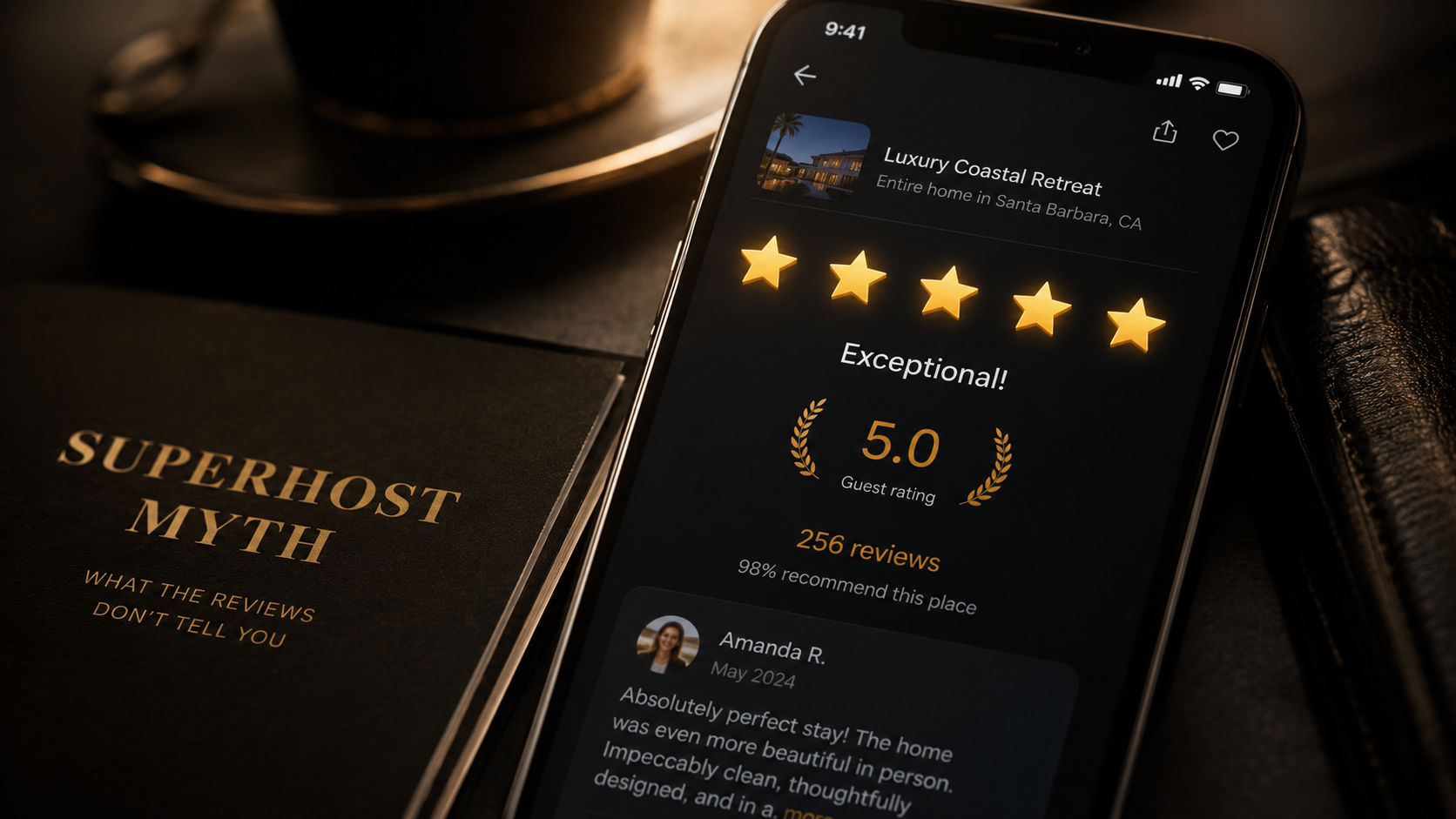
Ask any group of active Airbnb hosts what their primary platform goal is and a significant proportion will say Superhost status. It has become the default benchmark of STR performance — the thing hosts chase, celebrate when they achieve, and worry about when they are at risk of losing. But underneath the status anxiety, there is a question that is rarely asked clearly: does Superhost status actually make you more money?
The honest answer is more complicated than either the Airbnb marketing or the host community mythology suggests. And understanding what it actually does and does not do for your listing is commercially important — because the effort and operational focus required to maintain Superhost status could, in some cases, be better directed elsewhere.
What Superhost Status Actually Requires
To qualify for Superhost status on Airbnb, a host must meet four criteria assessed quarterly: a minimum of ten completed stays (or 100 nights across three or more stays) in the previous twelve months; an overall rating of 4.8 or above; a response rate of 90% or above; and a cancellation rate below 1%. The status is reviewed quarterly and can be lost if any criterion falls below the threshold.
These criteria are not arbitrary. They reflect the metrics that Airbnb believes are most strongly correlated with positive guest experience. A host who consistently meets all four criteria is, by definition, running a responsive, high-quality, reliable operation. The question is not whether these criteria are worth meeting — they clearly are. The question is whether the Superhost badge itself, as a visible status on the platform, generates a meaningful commercial return beyond what the underlying quality it represents would generate anyway.
What the Research Shows About Superhost Impact
The academic and industry research on Superhost status is less conclusive than the Airbnb promotional narrative suggests. A 2019 study published in the Journal of Marketing found that Superhost status was associated with a modest pricing premium — in the range of 5% to 8% above non-Superhost listings with comparable characteristics. However, the same study found that the premium was largely concentrated in markets with high listing density, where the badge served as a meaningful differentiator in a crowded search environment.
In markets with lower listing density — including many rural UK destination markets like the Lake District — the premium associated with Superhost status was smaller and less consistent. In these markets, the quality signals that guests actually use to evaluate listings — review scores, review volume, listing completeness, and photograph quality — appear to be weighted more heavily in booking decisions than the presence or absence of the Superhost badge.
AirDNA data on UK listing performance tells a similar story. The correlation between Superhost status and revenue per available room is positive but modest. The correlation between overall review score and revenue per available room is considerably stronger. The correlation between review volume and revenue per available room is stronger still. This suggests that the underlying quality that Superhost status requires is commercially valuable — but that the badge itself adds a relatively modest increment on top of what that quality would generate without it.
Carl McGlasson: I speak to hosts who are stressed about their Superhost status in a way that is genuinely disproportionate to its commercial significance. I have seen hosts accept bookings they had reservations about, bend their house rules in ways that created problems, and decline to report genuine property damage because they were worried about the impact on their response or cancellation metrics. The badge was driving decisions that were actively bad for their operation. That is the Superhost myth at its most damaging.
Where the Real Commercial Leverage Is
If the Superhost badge adds a modest premium, what drives the larger commercial differences between high-performing and average STR listings in the UK market? The data consistently points to three factors that dwarf the Superhost effect.
The first is review volume. Listings with a large number of reviews — regardless of whether they are Superhosts — rank higher in Airbnb search, convert better with prospective guests, and command stronger pricing power. Review volume is a compounding asset that grows with every booking and accumulates over the lifetime of a listing.
The second is listing quality — the completeness, accuracy, and visual appeal of the listing itself. Professional photography, a detailed and accurate description, a complete amenities list, and a listing that accurately represents what the property delivers are all factors that influence both search ranking and booking conversion more significantly than Superhost status.
The third is cleanliness and presentation. The gap between the revenue generated by listings in the top decile for cleanliness scores and those in the median decile is substantially larger than the gap between Superhosts and non-Superhosts.
Should You Still Chase Superhost Status?
The answer is yes — but for the right reasons. The criteria for Superhost status are worth meeting because they reflect genuine operational quality. What is not worth doing is optimising for the badge at the expense of the underlying quality. Chase the quality that Superhost status reflects. Do not chase the badge at the expense of the quality.
The Superhost myth is not that the badge is worthless — it is that it is worth less than the host community has decided it is, and that the obsession with it sometimes displaces focus from the things that actually move the commercial needle most significantly.